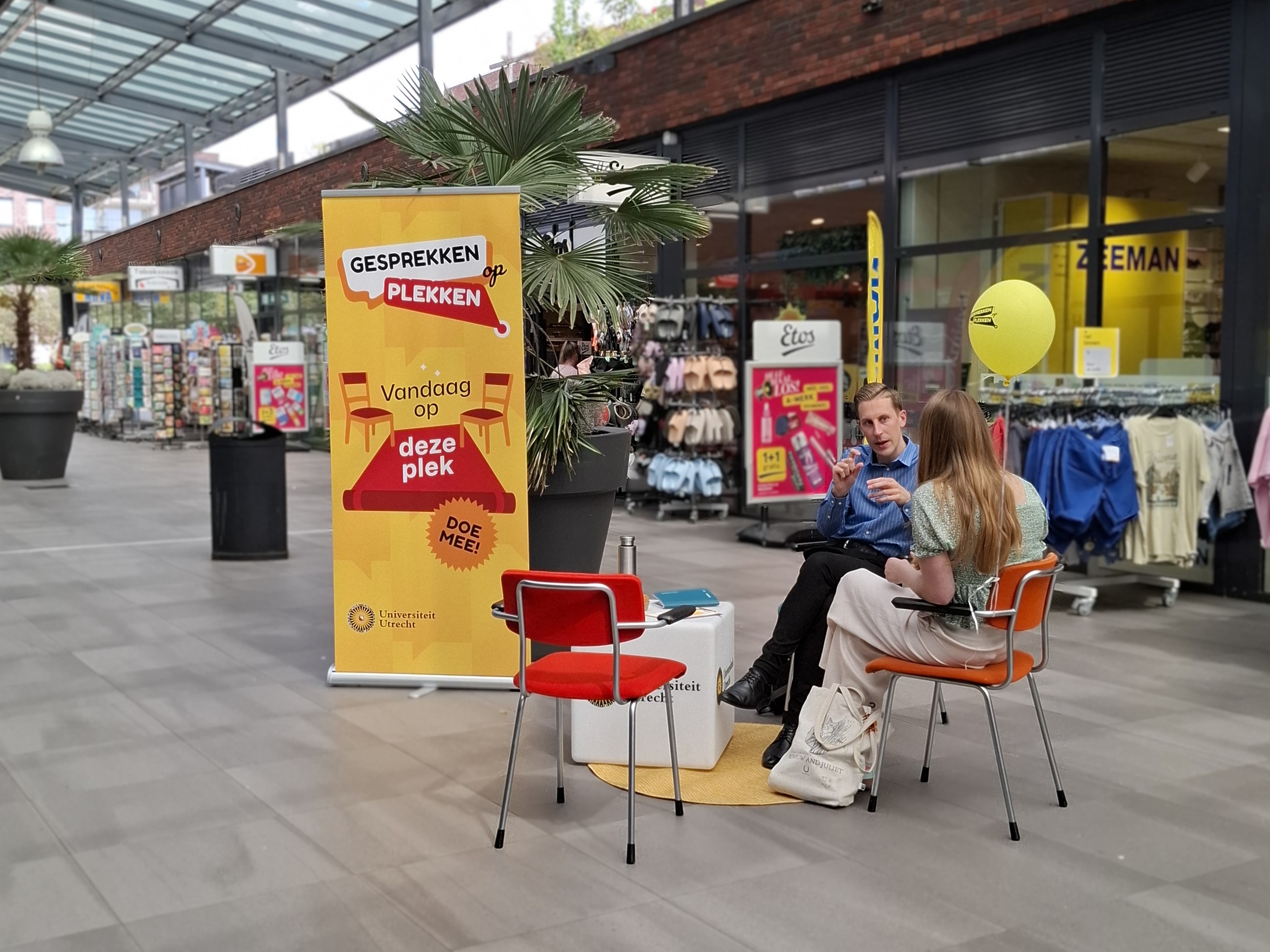
I participated in Talks Around Town, a creative initiative by Utrecht University to connect researchers with the wider public. The idea is that researchers sit in a public place (e.g., malls or libraries), and people who happen to pass by can join them for a 15-min chat about their research topic. Below is a full report of my experiences. The Science faculty has summarised them in the following article: 'It does something to people when the university seeks connection'.
It was a really lovely experience to connect with lots of people I wouldn't otherwise have reached. The interest was so great that I had four back-to-back conversations with 10 people in total. It was particularly amusing to step into my role as a researcher in the very place where I always do my own shopping.
I noticed that many people were curious, even if they didn't join in or weren't able to join in for a conversation afterwards. It clearly does something to people when the university reaches out to them. That's precisely why I thought Talks Around Town was such a wonderful initiative. I spoke to people of various ages, ranging from students who had just started their bachelor's degrees to people using walking frames. Some were researchers or teachers themselves, while others hadn't attended university.
Yet everyone could relate to my research focus on differentiation and AI in education. I found it fascinating how everyone approached the topic from their own perspective. Older people were particularly keen to know what AI actually is and were concerned about rapid technological progress and student motivation in general. A young father was critical of children's screen time. Students raised critical points regarding energy consumption and the misuse of recent generative AI. Teachers emphasised their own role and wanted to better understand the technical aspects of language models in order to assess how pedagogically acceptable they are. Even people who did not have an immediate connection to education drew parallels with the fields in which they were active and how generative AI was impacting them. Everyone was in favour of a more differentiated education for all. As a researcher, I learnt that many of the themes I work on are relevant on a societal scale. That gave me some reassurance and boosted my confidence. As a science communicator, I learnt that it is very important to be flexible during such conversations. Everyone had different questions and experiences, so I had to adapt my narrative accordingly.
What I particularly appreciated was that, at the end, many people said they'd really enjoyed having a chat with a researcher and hearing a more nuanced perspective in the debate about AI in education. Many felt that the discussion often revolves around ‘good' or ‘bad', with little room in between. Instead of specific, context-dependent discussions, the conversation all too often revolves around AI as a monolithic entity, even though research shows that context is very important, as different contexts can lead to different conclusions. I'm glad that, as a researcher, I was able to play a small part in bringing this to light, and I found it striking that even such brief conversations could reinforce that realisation.